
Give repeatable work to systems that execute it.
One process for building agents your team can actually trust.
Relevant
Growth, intelligently executed.
Give AI a defined job instead of an open mandate.
Most AI pilots stall between experimentation and impact because no one has defined the task, the data it can use, the output it should produce, or who reviews it before it moves downstream.
Talk to usRepeatable work handled without adding headcount
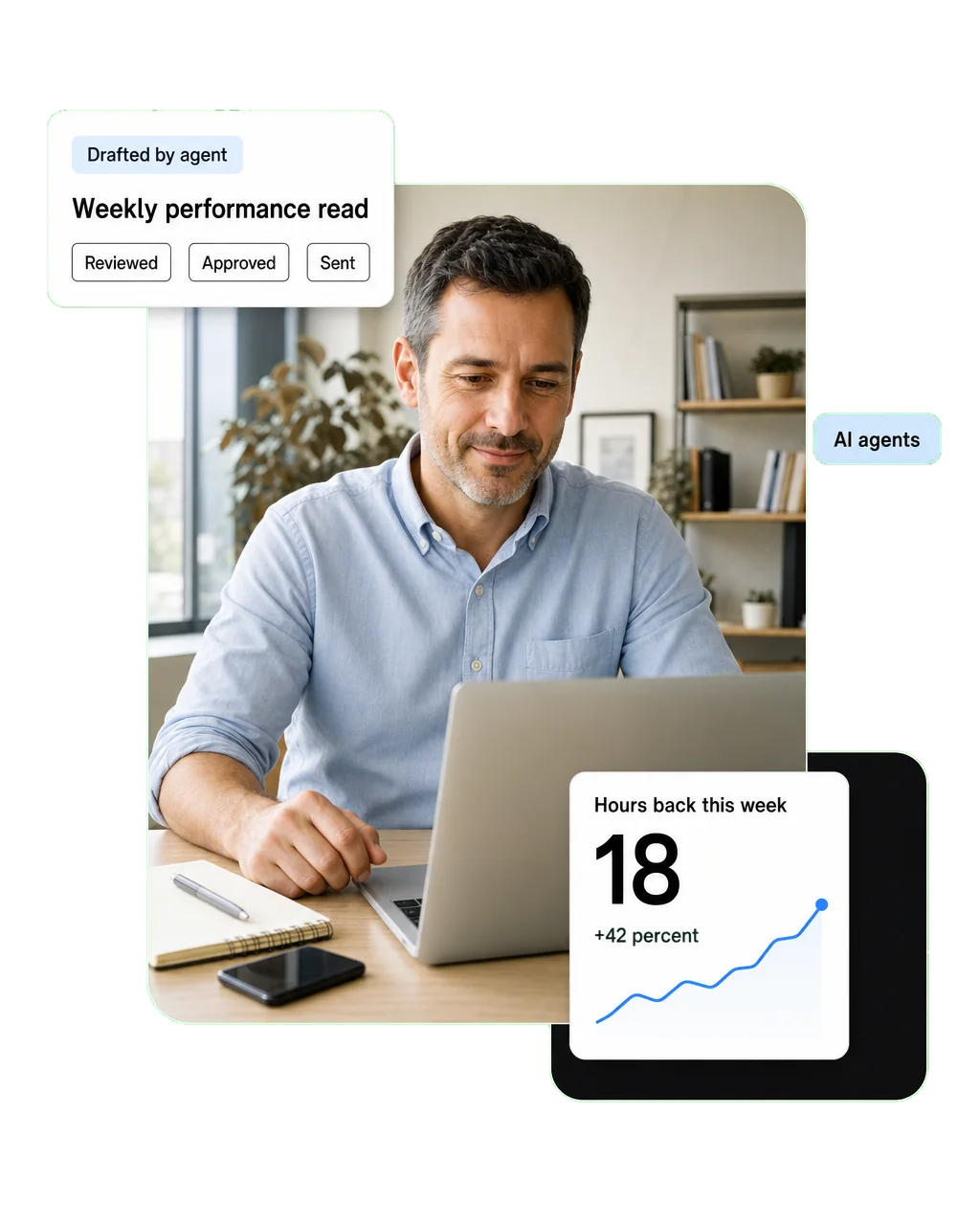
Agents take on defined, repeatable tasks so senior team members spend time on judgment and strategy instead of assembly.
A human review point that actually holds
Every agent has a defined role, approved data access, and a point where a person reviews the output before it moves downstream.
Faster analysis and reporting cycles
Research, monitoring, and reporting that used to take hours move faster, surfacing exceptions your team can act on sooner.
Give the agent one defined job.
The same sequence governs every engagement. Scope follows the workflow, data access, and review requirements involved.
Analysis
Map the workflow, the decision points inside it, and where a defined agent could remove manual effort.
Strategy
Define the agent's role, data access, expected output, and the point where a person reviews its work.
Implementation
Build and connect the agent to the approved data sources and systems it needs to do the job.
Optimization and reporting
Monitor output quality, adjust the agent's scope, and report what it's actually producing.
The components of a defined, reviewed agent.
Each component can stand alone or run as part of a full deployment. Your team keeps final approval and accountability throughout.
Use case and role definition
Define the specific task and decision points the agent owns, and where its authority stops.

Approved data and permissions
Connect the agent only to the data sources and systems it needs, with permissions your team controls.

Human review points
Build in a defined point where a person reviews the agent's output before it moves downstream.

Monitoring and iteration
Track what the agent is actually producing and adjust its scope, prompts, or data access as needed.
For workflows worth automating carefully.
- A task defined enough to hand off. The task is repeatable and well-defined enough that an agent's output can be evaluated against a clear standard.
- A workflow with real coordination cost. The workflow touches multiple data sources, tools, or steps that currently depend on manual coordination.
- Someone who reviews the output. An internal owner approves data access, reviews output, and holds accountability for what the agent produces.
The work agents are built to handle.
Research and monitoring
Agents track sources, competitors, or account changes and surface what needs attention.
Analysis and reporting
Agents assemble and summarize performance data into a reviewable draft.
Content operations
Agents handle repeatable content tasks like formatting, tagging, or first-pass drafts.
Workflow coordination
Agents move information and tasks between systems on a defined trigger.
What to know before we start.
Scope depends on the workflow, data access, and review requirements involved.
Ask about your accountWhat does brlvnt manage within AI agents?+−
Scope can include use-case definition, data and permission scoping, agent build, human review design, and ongoing monitoring. Final scope reflects your systems and risk tolerance.
Does an agent replace a role on our team?+−
No. Agents take on defined, repeatable tasks under a human review point. Accountability for decisions stays with your team.
What data can an agent access?+−
Only the data sources and systems your organization approves. Access is scoped to the task, not left open by default.
Who reviews what the agent produces?+−
A defined person on your team or ours, depending on the workflow, reviews output before it moves downstream. That review point is built into the agent's design.
How long does it take to build and deploy an agent?+−
It depends on the workflow's complexity and the systems it needs to connect to. We define the task and scope before estimating a timeline.
How does AI change this kind of work?+−
AI accelerates the repeatable parts of a workflow: research, analysis, drafting, monitoring. Human judgment remains responsible for strategy, approval, and any decision with real consequences.
Connected by design.
Bring us the repeatable work no one has time for.
Share the workflow, the data it touches, and who would need to review its output. We'll identify whether an agent fits.